How effective Owner Interface Management, clear rules of engagement and decision-led role clarity can improve alliance performance.
Major infrastructure alliances depend on far more than the capabilities of the alliance delivery team. They also depend on the knowledge, expertise, decision-making and support of the Owner Alliance Participant and its broader organisation.
Within most infrastructure owners sits a significant pool of subject matter experts (SMEs) across engineering, planning, environment, property, commercial, finance, operations and asset management. These individuals hold valuable organisational knowledge, understand the owner’s requirements and can significantly influence alliance outcomes. Yet one of the recurring challenges in alliancing is how to effectively engage, coordinate and integrate these experts into the alliance delivery model.
Unlike traditional contracting arrangements, an alliance brings the owner and non-owner participants together to collaboratively deliver agreed outcomes, share risks and opportunities, and operate under a common governance and commercial framework. This creates a different set of expectations for the owner and its people.
Without clear roles, accountabilities and agreed ways of working, well-intentioned SME involvement can create duplication, conflicting advice, delayed decisions, unnecessary rework and frustration between the owner organisation and alliance delivery team.
This is where an effective Owner Interface Management (OIM) team becomes critical. The OIM function is not simply about managing communications between the owner and the alliance. It is about ensuring the owner’s expertise, organisational knowledge and decision-making capability contribute positively to alliance performance to “make the boat go faster and smoother”.
1. The OIM Team: An Enabler of Alliance Performance
The fundamental purpose of the OIM team is to connect the Owner Alliance Participant’s broader organisation with the integrated alliance delivery team. An effective OIM function should:
- Provide access to the owner’s technical expertise, organisational knowledge and decision-makers.
- Ensure the owner’s strategic objectives, requirements and minimum outcomes are understood.
- Coordinate the involvement of SMEs across different functional areas.
- Facilitate timely decisions, approvals and resolution of interface issues.
- Promote constructive relationships and consistent communication.
- Support the Alliance Management/Leadership Team (AMT/ALT) and Project Alliance Board (PAB) in achieving alliance objectives.
- Protect the owner’s legitimate organisational interests while supporting best-for-alliance outcomes.
Importantly, the OIM team should not become another layer of bureaucracy, assurance or approvals. Its role is to enable the alliance, not slow it down. This requires a clear understanding of where the OIM team adds value, how SMEs interact with alliance personnel and who has the authority to make decisions.
The most effective OIM teams influence alliance outcomes from within the alliance, rather than simply reviewing them from outside.
2. Decision Clarity Must Come Before Role Clarity
One of the most common challenges in managing owner SMEs is confusion between providing technical advice, making recommendations and having authority to make decisions. An SME may be the most technically knowledgeable person in the room. However, this does not necessarily mean they have the authority to approve a design, direct the alliance delivery team or commit the Owner Alliance Participant.
This distinction is fundamental. In a previous BRS article, Why DARCSI Beats RACI Every Time, we argued that major infrastructure delivery should start with decisions rather than responsibilities.
DARCSI provides a practical framework:
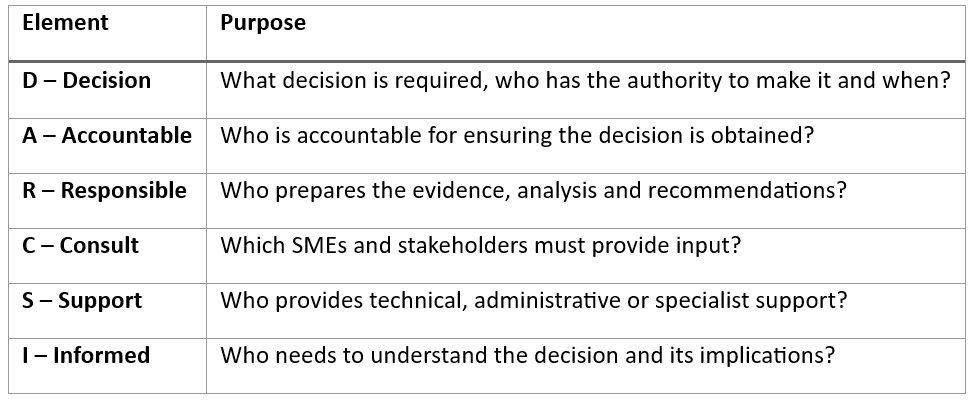
For an alliance OIM team, this framework is particularly powerful.
Rather than beginning with a lengthy discussion about everyone’s responsibilities, the OIM team and alliance leadership should identify the critical decisions required to achieve alliance objectives. For each decision, they should establish who holds the authority, who is accountable for progressing it, what evidence is required, which SMEs must contribute and when the decision is needed.
Importantly, the framework must distinguish between decisions delegated to the integrated alliance team, decisions reserved for the PAB and decisions that remain with the Owner Alliance Participant under its organisational delegations. DARCSI should reinforce the agreed alliance governance framework, not create an alternative decision-making structure. This approach prevents situations where multiple SMEs believe they have approval rights, technical advice becomes an instruction or the alliance waits unnecessarily for decisions.
SMEs should be empowered to contribute their expertise without creating competing lines of authority within the alliance. The OIM team has an important role in coordinating this process and ensuring the appropriate people are involved at the right time.
3. Developing Rules of Engagement with Owner SMEs
One of the most valuable activities an alliance can undertake is to collaboratively develop agreed Rules of Engagement between the OIM team, owner SMEs and alliance delivery personnel. These rules establish how people will interact, communicate, make decisions and resolve issues. They should be developed through facilitated workshops rather than imposed by the owner or alliance leadership.
Four questions provide an effective starting point which is referenced from the excellent Think One Team partnering quadrant model developed by Graham Winter.
What is important to us?
Establish shared priorities around safety, public value, alliance objectives, programme performance, quality, collaboration and the owner’s minimum requirements.
What do we expect from each other?
Agree expectations for responsiveness, early engagement, transparency, constructive challenge, accountability and no surprises.
What will we commit to?
Develop mutual commitments around quality briefs, timely advice, reliable forward workload information, decision-making and issue resolution.
How will we communicate?
Agree communication channels, response times, meeting rhythms, reporting requirements, escalation pathways and how disagreements will be managed.
These discussions should translate into practical commitments, including:
- Owner SMEs are engaged early, before critical alliance decisions are effectively locked in.
- Technical advice is provided through agreed communication channels.
- SMEs and alliance personnel can challenge each other’s assumptions constructively.
- No individual provides instructions or commitments beyond their delegated authority.
- Emerging risks and issues are raised early, with no surprises.
- Conflicting technical advice is resolved through agreed alliance processes.
- Decisions and their rationale are documented and communicated.
- Both parties respect agreed response times and delivery commitments.
- Issues are resolved at the lowest appropriate level before being escalated through alliance governance.
The Rules of Engagement should be supported by a DARCSI matrix that makes decision rights and accountabilities explicit. DARCSI establishes who contributes to alliance decisions. The Rules of Engagement establish how people work together to achieve them.
4. Seven Principles for Effective Owner Interface Management
A high-performing OIM team should operate around seven key principles.
1. Influence alliance outcomes from within the alliance. The OIM team should be actively engaged in alliance delivery, helping the integrated team understand the owner’s objectives, constraints and requirements before critical decisions are made.
2. Demonstrate visible leadership. The OIM and SMEs should role model the alliance’s agreed principles and behaviours, including openness, respect, accountability, no-blame and constructive challenge.
3. Communicate consistently to build confidence. The owner should communicate a clear and aligned position while ensuring different technical perspectives are considered and resolved appropriately.
4. Make issues visible and resolve them early. Issues should be raised proactively and resolved at the lowest appropriate level, with clear escalation pathways through the ALT/AMT and PAB where required.
5. Enable timely, informed decisions. Decisions should be supported by the right evidence, technical expertise and delegated authority, with DARCSI providing clarity around individual contributions.
6. Build trust and constructive relationships. Trust develops through reliability, transparency, timely responses and delivering on commitments. This is particularly important where owner SMEs retain responsibilities within their home organisation.
7. Promote a best-for-alliance culture. SMEs and alliance personnel should focus on achieving the agreed alliance objectives rather than defending organisational positions or established ways of working. These principles should guide everyday behaviours, not simply appear in an Owner Interface Management Plan. Living the Alliance Principles is critical to achieving this.
5. Managing SMEs Requires Leadership, Not Just Coordination
Technical expertise alone does not guarantee effective collaboration. Some owner SMEs are accustomed to traditional client-side arrangements where their primary role is to review, approve or enforce standards. This is appropriate for design and construct, construct only or other delivery models where risk is allocated to the party best placed to manage the risk commercially and technically. Alliancing requires a different approach due to the shared risk model.
Rather than simply identifying why a proposed solution does not meet an established requirement, SMEs should work collaboratively with alliance personnel to identify how the required outcome can be achieved. This does not mean compromising mandatory standards, safety, regulatory obligations or the owner’s legitimate requirements. It means adopting a solutions-focused approach consistent with alliance principles.
The OIM team should ensure through Alliancing 101 and OIM 101 training that SMEs understand the alliance’s objectives, governance arrangements, commercial framework, key result areas and collaborative principles. SME involvement should also be planned and integrated into the alliance delivery programme. Critical decisions should be identified early, with the required technical input, evidence and approval pathways established in advance. The OIM must also manage SME availability and competing organisational priorities, recognising that many SMEs are supporting the alliance while continuing to fulfil responsibilities within their home organisation.
A technically sound recommendation delivered too late may have limited value. The effectiveness of an SME should be measured not simply by the quality of their technical advice, but by how that advice contributes to better alliance outcomes.
6. Protecting the Owner’s Interests While Enabling Best-for-Alliance Outcomes
An important distinction in alliancing is that acting in the best interests of the alliance does not mean abandoning the owner’s interests. The Owner Alliance Participant remains accountable for achieving its investment objectives, protecting community interests, delivering public value and ensuring assets meet operational and whole-of-life requirements. At the same time, the alliance governance model requires participants to work collaboratively and make decisions consistent with the agreed alliance objectives. The OIM team plays an important role in maintaining this balance.
SMEs should be encouraged to challenge proposals where necessary, particularly where decisions could adversely affect cost, programme, quality, safety or whole-of-life value. Equally, the alliance delivery team should be encouraged to challenge the owner’s assumptions and requirements where opportunities exist to improve outcomes. This two-way challenge is fundamental to achieving innovation and value for money.
The key is ensuring that challenge remains constructive, evidence-based and directed through agreed alliance decision-making arrangements. The OIM function should help resolve potential tensions between organisational requirements and alliance objectives before they become governance disputes.
7. Measuring the Effectiveness of the Owner Interface
The performance of an OIM team should not be assessed by the number of meetings held, reports produced or approvals processed.
More meaningful measures include:
- Timeliness of SME engagement and technical advice.
- Decision turnaround times against agreed alliance requirements.
- Number and age of unresolved owner interface issues.
- Quality and consistency of owner requirements and alliance briefs.
- Rework arising from late or conflicting SME input.
- Collaboration effectiveness between the owner organisation and alliance team.
- Achievement of alliance objectives and key result areas.
These measures should be reviewed jointly by the OIM and ALT/AMT, with material issues escalated through the agreed governance arrangements.
Where performance falls short, the focus should be on understanding the underlying causes and improving the way the parties work together. Importantly, the OIM team’s performance should be linked to the alliance’s broader Alliance charter, programme and project objectives, key result areas and outcomes, rather than a separate set of organisational priorities.
Conclusion: The Quality of the Owner Interface Shapes Alliance Performance
Major infrastructure alliances are established to bring together the capabilities, expertise and resources of the owner and non-owner participants to achieve outcomes that would be difficult to deliver through traditional contracting arrangements. However, the integrated alliance team is only one part of the equation. The capability of the owner organisation, and particularly its ability to effectively engage its own SMEs, is equally important.
A high-performing OIM team provides the connection between the owner’s broader organisation and the alliance, ensuring expertise is accessible, requirements are clear, decisions are timely and relationships remain constructive. Achieving this requires more than appointing an Owner Interface Manager. It requires clear decision rights through DARCSI, agreed Rules of Engagement, visible leadership, empowered SMEs and a genuine commitment to alliance principles. When these elements are in place, the OIM function becomes a significant enabler of alliance success.
The best owner interface teams do not simply manage the relationship between the owner organisation and the alliance. They actively improve the performance of both. The OIM function should enable the integrated alliance team, not become a parallel owner-side management structure.
And ultimately, alliances do not move at the speed of their organisational structures or reporting processes.
They move at the speed of their decisions and their ability to resolve issues in a timely manner with their owner on their project.