The announcement of the new NEC4 Project Alliance Contract (PAC) is an important development in the international evolution of collaborative contracting.
Scheduled for publication in late 2026, PAC will be a fully integrated, multi-party alliance contract bringing together the client and key suppliers to design and deliver an asset through a collaborative, two-stage process. It incorporates multi-party governance, joint risk management, shared objectives and incentives, early supply-chain involvement, unanimous Core Group decision-making and an optional “no blame, no claim” approach.
For Australian and New Zealand infrastructure practitioners, much of this will sound familiar. Australia and New Zealand have spent more than two decades developing and applying project alliancing to complex infrastructure. The Australian National Alliance Contracting Policy and Guidelines, together with the extensive practical experience developed across Australian and New Zealand infrastructure delivery agencies, have established a mature model based on integrated teams, collective governance, best-for-project decision-making, joint risk management, open-book commercial arrangements, Target Outturn Cost development and painshare/gainshare mechanisms.
PAC therefore should not be viewed as the invention of a fundamentally new collaborative model. Rather, it represents an important international convergence around many principles that have underpinned Australian and New Zealand alliancing for years.
There are, however, meaningful differences. The NEC approach appears likely to bring greater contractual structure to some of the day-to-day management disciplines of an alliance through established NEC mechanisms including early warnings, programme management and compensation events. Australian and New Zealand alliancing, by comparison, has traditionally placed particularly strong emphasis on behavioural alignment, integrated leadership, collective accountability, best-for-project decision-making and the creation of a genuinely high-performing alliance culture. The opportunity is therefore not to debate which model is superior. It is to ask:
What can NEC4 PAC learn from more than two decades of Australian and New Zealand alliancing experience and what can Australian and New Zealand infrastructure owners learn from NEC’s highly disciplined approach to collaborative contract management?
The answer may point toward the next generation of collaborative contracting.
A Significant Moment for Collaborative Contracting
Infrastructure delivery is becoming harder. Projects are larger, interfaces are more complex, stakeholder expectations are increasing, supply chains are constrained and governments are demanding greater certainty around cost, schedule, productivity and outcomes. At the same time, the limitations of highly transactional contracting models are increasingly apparent on projects where uncertainty cannot sensibly be transferred. Collaborative contracting attempts to address this problem differently.
Rather than assuming that every major risk can be allocated contractually before delivery begins, collaborative models recognise that some uncertainty is better managed collectively by bringing the owner, designer, constructor and key supply chain participants together. The Australian National Alliance Contracting Guidelines describe alliance contracting as an integrated procurement method under which the government client works collaboratively with private-sector suppliers. Alliance participants operate as an integrated team, make best-for-project decisions and jointly manage project delivery risks. NEC is now moving further in the same direction.
The forthcoming NEC4 PAC is intended to succeed the existing NEC4 Alliance Contract and PPC2000. NEC describes PAC as a fully integrated multi-party contract designed to enable a client and suppliers to work together to design and construct an asset in a collaborative two-stage environment. This is significant. Collaborative contracting is moving further into the international mainstream.
What Is NEC4 PAC?
Based on NEC’s published information ahead of the final contract’s release, PAC contains several defining characteristics. It is a multi-party contract rather than a collection of bilateral contracts. The client and participating suppliers form an alliance with shared objectives and delivery mechanisms. Pre-construction collaboration is built into the model as a fundamental requirement rather than simply an optional preliminary activity. Governance operates through a Core Group, with each Alliance Member represented and key decisions requiring unanimous agreement. Day-to-day delivery is led by an Alliance Manager.
The model incorporates:
- alliance integration;
- joint risk management;
- shared objectives;
- common targets and timetables;
- performance incentives;
- early supply-chain involvement;
- value improvement;
- early-warning mechanisms;
- programme management;
- compensation events;
- a combined duty of care; and
- an optional no-blame/no-claim approach.
These mechanisms sit within NEC’s established philosophy of clarity, simplicity and active contract management. This last point is important. PAC is not simply attempting to make contracting more relational. It is attempting to combine relational collaboration with disciplined project-management processes.
The Australian New Zealand Alliancing Model
Australia and New Zealand have been international leaders in infrastructure alliancing. The Australian National Alliance Contracting Guidelines formalised many practices that had developed through major infrastructure programmes. New Zealand subsequently developed extensive practical capability through NZ Transport Agency and other major public infrastructure owners, adapting collaborative procurement approaches to the New Zealand environment. Although individual alliance agreements differ, the model generally incorporates several core principles.
1. One integrated team
Owner Participants and Non-Owner Participants operate through an integrated alliance rather than protecting organisational boundaries. The project is intended to be delivered by one team, not by a client supervising contractors.
2. Best-for-project decision-making
Alliance leaders are expected to make decisions according to what produces the best outcome for the project rather than simply protecting the commercial position of their parent or home organisation.
3. Collective governance
An Alliance Leadership Team or equivalent (eg PAB) provides collective strategic governance, typically operating through unanimous decision-making. An Alliance Management Team manages integrated delivery.
4. Joint risk management
Risk is managed collectively rather than simply transferred down the contractual chain.
5. Open-book commercial arrangements
Actual project costs are generally transparent and reimbursed according to the commercial framework.
6. Target Outturn Cost
Owner and Non-Owner Participants collaboratively develop the Target Outturn Cost or equivalent target.
7. Painshare/gainshare
Commercial outcomes are linked to collective alliance performance rather than the individual commercial performance of each participant.
8. No blame
Pure alliance models substantially restrict the circumstances in which participants pursue claims against each other.
9. Behavioural alignment
Considerable attention is typically given to behavioural assessment, alliance establishment, leadership alignment, team development and the creation of a high-performing culture. It is this final characteristic that has become one of the distinguishing features of mature Australian and New Zealand alliancing.
PAC and the Australian–New Zealand Model: Side by Side
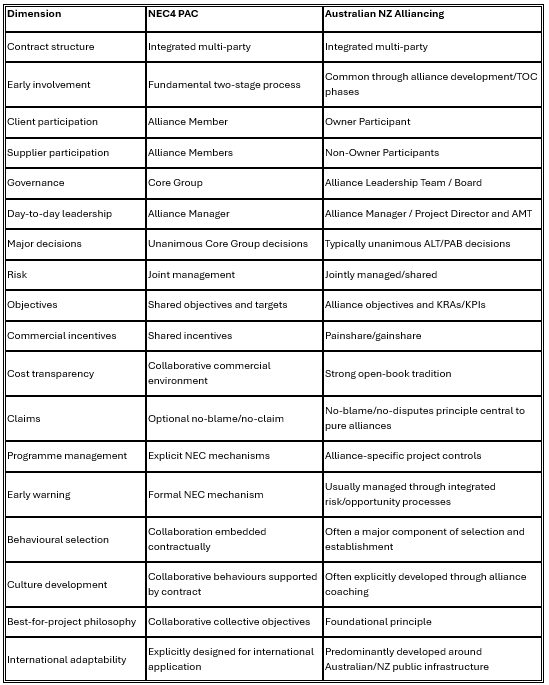
The similarities are considerable. The more interesting questions therefore lie in the differences which this paper will explore further.
Difference One: Collaboration by Contract Versus Collaboration by Capability
One of the strengths of NEC is its ability to turn good project-management behaviours into contractual processes. Early warning is perhaps the best-known example. Rather than allowing emerging problems to remain hidden until they become contractual disputes, NEC requires risks to be surfaced and managed early. PAC appears likely to extend this disciplined philosophy into an alliance environment.
Australian and New Zealand alliancing has often approached the challenge from another direction. The contract establishes the commercial architecture, but significant effort is then invested in creating the leadership and behavioural capability required to make the model work.
This can include:
- behavioural assessment during procurement;
- leadership alignment;
- alliance establishment workshops;
- behavioural charters;
- development of high-performance objectives;
- integrated leadership coaching;
- team effectiveness interventions;
- conflict resolution;
- commercial-acumen development; and
- ongoing alliance health assessments.
This experience has produced an important lesson. A collaborative contract does not create a collaborative team. The contract creates the conditions within which collaboration can occur. People and organisations determine whether it actually does. PAC users internationally should therefore resist assuming that adopting a sophisticated multi-party contract automatically produces alliance behaviour.
Difference Two: The Importance of Behavioural Selection
Australian and New Zealand alliance procurements have frequently placed significant weight on the behaviours and leadership capability of proposed alliance participants. That matters because an alliance fundamentally changes what is required from senior project leaders. The technically strongest project director in a traditional D&C environment is not necessarily the strongest alliance leader.
Alliance leaders need to:
- work across organisational boundaries;
- manage competing perspectives;
- make best-for-project decisions;
- challenge constructively;
- operate transparently;
- share incomplete information;
- resolve conflict early and optimise the shared risk model;
- balance relationships with commercial discipline; and
- lead collectively rather than hierarchically.
These are capabilities, not contractual clauses. The international implementation of PAC should therefore consider behavioural capability as part of procurement, not something addressed after contract award. From my perspective, this may be one of the most important lessons Australia and New Zealand can offer.
Difference Three: NEC’s Contract-Management Discipline
There is also something Australia and New Zealand can learn from NEC. Alliance practitioners sometimes talk about collaboration as though good relationships remove the need for disciplined management. They do not. High-performing collaboration requires more management discipline, not less.
NEC’s established mechanisms around:
- early warnings;
- programme acceptance;
- risk management;
- compensation events;
- responsibilities;
- information flows; and
- active contract administration
These mechanisms provide a strong operating rhythm for project delivery.
Australian and New Zealand alliances have sophisticated project-control systems, but there can still be a tendency for teams to rely too heavily on relationships and informal resolution. The next generation of alliancing should combine:
strong relationships + strong systems + strong commercial discipline and acumen.
Collaboration should never become an excuse for ambiguity.
Difference Four: Target Development Is Where the Alliance Is Often Won or Lost
One of the strongest lessons from Australian and New Zealand experience concerns development of the Target Outturn Cost. The target is much more than a number. The development phase creates an opportunity for the owner, designer and constructor to collectively:
- understand scope;
- interrogate risk;
- optimise design;
- test constructability;
- examine staging;
- engage the supply chain;
- challenge assumptions;
- establish project controls; and
- develop confidence in the delivery strategy.
PAC’s mandatory pre-construction alliance activities therefore represent an important feature. But the Australian and New Zealand experience suggests a caution. Early contractor involvement only creates value when the development phase is genuinely used to improve the project. If the process simply becomes an extended negotiation over price, much of the benefit disappears. The development phase should be treated as a period of intensive collaborative optimisation.
Difference Five: Best-for-Project Is Easy to Say and Hard to Practice
Perhaps the most important phrase in Australian and New Zealand alliancing is:
Best for Project.
It sounds straightforward. In practice, it is one of the hardest behaviours to achieve. Every participant enters an alliance carrying:
- organisational incentives;
- commercial pressures;
- professional loyalties;
- previous contracting experiences including different delivery models;
- internal approval processes; and
- individual career considerations.
A multi-party agreement does not make those forces disappear. Alliance leaders must therefore learn to distinguish between:
What is best for my organisation?
and
What is best for the project?
The most mature alliances recognise that these tensions cannot simply be contracted away. They need to be surfaced and managed. This is where alliance governance, behavioural maturity and commercial acumen intersect.
The Owner Remains Critical
Perhaps the biggest lesson from Australian and New Zealand alliancing is that collaborative contracting places greater demands on the owner, not fewer. An owner cannot procure an alliance and then stand outside it administering the contract. It becomes a participant.
That requires strong owner capability in:
- governance;
- commercial decision-making;
- procurement;
- risk;
- project controls;
- stakeholder management;
- leadership;
- collaboration; and
- assurance.
This is particularly important during development of the commercial framework and target cost. An owner who is not mature and intelligent can enter a collaborative model believing that collaboration substitutes for commercial capability. The opposite is true.
The more collaborative the delivery model, the more commercially capable the owner needs to be. Without that capability, transparency can become dependence and collaboration can become an imbalance of information and expertise.
Commercial Acumen and Collaboration Are Complements, Not Opposites
There remains a misconception that collaborative contracting requires parties to become less commercially focused. Successful alliances demonstrate the opposite. Collaboration without commercial acumen can produce comfortable relationships but poor outcomes. Commercial acumen without collaboration can produce defensive behaviour, claims and local optimisation. The objective is to combine both.
Participants need to understand:
- the Alliance commercial model;
- cost drivers;
- risk allocation;
- incentives;
- decision consequences, approvals and issue resolution;
- supply-chain economics;
- programme impacts; and
- whole-of-project value.
The question should therefore not be:
Should we be collaborative or commercial?
It should be:
How do we become commercially astute enough to collaborate effectively?
Where PAC Could Learn From Australia and New Zealand
More than two decades of practical alliancing experience suggests several areas that should receive particular attention as PAC is adopted internationally which include:
1. Select for behaviour as well as technical capability
The people leading the alliance matter enormously.
2. Invest heavily in alliance establishment
Do not assume signing the contract creates integration.
3. Develop explicit behavioural expectations
Define what collaboration, constructive challenge, accountability and best-for-project behaviour actually look like in a practical sense. These items are a verb not a noun.
4. Coach the leadership system
The Core Group and Alliance Manager will shape the behaviour of the entire alliance.
5. Measure alliance health
Culture and collaboration should be monitored just as deliberately as cost, schedule and safety.
6. Build owner commercial capability
The owner must remain an intelligent, informed and active participant that is proactive and not reactive.
7. Treat the development phase as project optimisation
Do not allow it to become simply a prolonged pricing exercise.
Where Australia and New Zealand Could Learn From NEC
The learning should flow in both directions. Australian and New Zealand alliances could benefit from greater emphasis on several characteristics embedded in the broader NEC philosophy.
1. Make early warning systematic
Problems should be surfaced before they become positions.
2. Strengthen programme discipline
Collaborative teams still require clear commitments and reliable planning.
3. Clarify management processes
Not every problem should require leadership intervention.
4. Connect collaboration to operational routines
Culture should exist in how meetings, decisions, risks, programmes and changes are managed not merely in behavioural charters. Define and make explicit the operating model.
5. Preserve commercial tension
Constructive challenge is healthy. High-performing alliances should not confuse harmony with performance.
The Bigger Opportunity: Collaborative Contracting 2.0
PAC’s introduction suggests that collaborative contracting is entering another stage of maturity. The first generation of infrastructure contracting largely attempted to allocate risk. Alliancing increasingly focused on sharing and collectively managing risk. The next generation should go further and create an integrated system capable of making better decisions about risk, opportunity and value.
That requires five elements working together which are:
- Commercial model. Align incentives around overall project performance.
- Governance. Put decisions at the appropriate level and make accountability clear.
- Management systems. Create disciplined mechanisms for programme, risk, cost, change and early warning.
- Leadership and culture. Develop the behaviours and principles required for transparency, challenge and collaboration.
- Commercial acumen. Ensure participants understand the consequences of the decisions they make.
No single element is sufficient. The contract is the architecture. Performance comes from the operating system built inside it.
Implications for Infrastructure Owners and Delivery Agencies.
Before selecting PAC, an Australian/NZ-style alliance or another collaborative model, owners should ask a more fundamental set of questions.
1. Why do we need collaboration? What uncertainty, complexity or opportunity makes collaborative delivery preferable?
2. What decisions need to be made collaboratively and by who? Start with decisions rather than organisational charts.
3. What capability does the owner need to retain? Collaboration must not become abdication.
4. How will commercial tension be maintained? Collaboration and challenge must coexist.
5. What behaviours and principles will differentiate high performance? Define them before procurement.
6. How will we know whether collaboration is actually working? Measure behavioural and project team health alongside project outcomes. And perhaps most importantly:
7. Are we genuinely prepared to behave differently as an owner? An organisation cannot procure collaboration from its suppliers while continuing to behave transactionally itself.
Conclusion
The forthcoming NEC4 Project Alliance Contract represents an important endorsement of collaborative contracting internationally. For Australian and New Zealand practitioners, many of its fundamental ideas are familiar: multi-party contracting, integrated teams, joint risk management, collective governance, shared incentives, early contractor involvement and collaborative decision-making have been central to infrastructure alliancing for decades. But familiarity should not produce complacency.
NEC brings an impressive tradition of disciplined contract management, explicit processes and early intervention that can strengthen alliance delivery. Conversely, Australia and New Zealand bring something equally valuable: decades of experience demonstrating that collaboration is ultimately a human capability, not a contractual mechanism. The strongest future model may therefore combine both traditions. The discipline of NEC. The commercial architecture of alliancing. The behavioural maturity developed through Australian and New Zealand collaborative infrastructure delivery. And an increasingly sophisticated owner capable of integrating all three. The question for infrastructure leaders is consequently no longer simply:
“Which contract should we use?”
A much better question is:
“What commercial, governance, management and behavioural system will give this project the greatest probability of success?”
That is where the next evolution of collaborative contracting will occur.